ANALYSIS
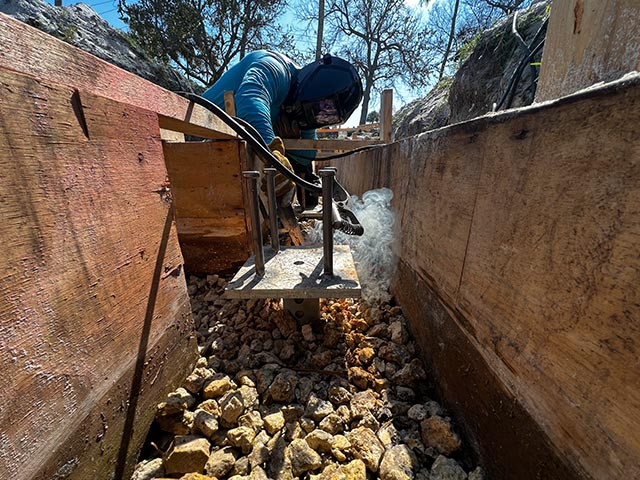
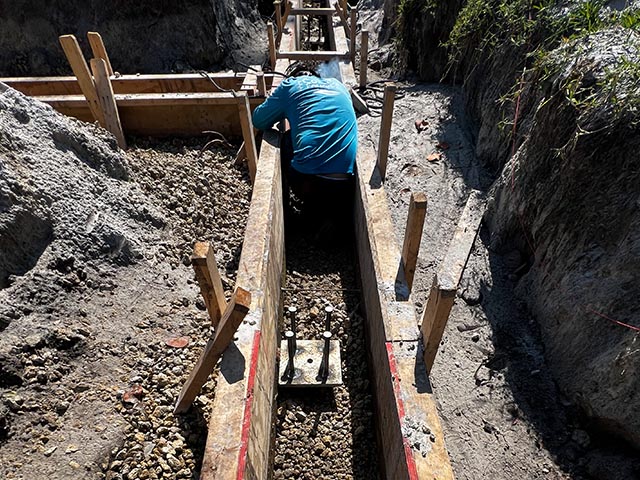
Coastal and beachfront projects often require dynamic foundation stabilization solutions due to varying soil conditions. This project was no exception. Our team was hired to install helical piles to strengthen a foundation on Gulf Shore Blvd. in beautiful Naples, Florida.
SOLUTION
Providing immense support, helicals were selected to provide exceptional foundational strength and stabilization. Originally, our team was to install 12 piles, but 5 of those piles did not achieve the required capacity and hit refusal therefore, the E.O.R. requested a helper piling 36″ away from the all refusal piles.
Refusal or “Spin- out” of a helical pile occurs when the pile refuses to penetrate while continuing to rotate during installation. Spin-out can occur when the soil’s resistance to penetration exceeds the downward thrust generated by the helix plates and the crowd pressure applied by the 28,000# excavator. Spin-out usually occurs at the conversion between a dense soil layer and bedrock when the helix plates confront hard/very dense material. Helical pile spin-out (refusal) affects the load capacity, and the means to predict said capacity via torque correlation. Once the helical pile tip (3.5” Diameter) encounters lime rock, the installation torque can no longer be commuted. The digital torque indicator may only record as the helical pile is progressing and creating torque resistance. Therefore, the bearing capacity of spin-out piles can only be determined definitively with an actual static load test. When the helical pile has spun-out on bedrock, the capacity can be assumed to be limited to the structural strength of the bottom-most helix plate – assuming the bedrock is strong enough to bear the load.
RESULT
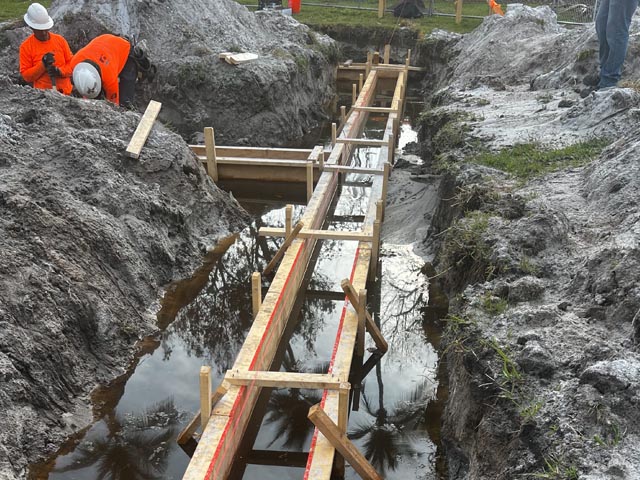
In total our team installed 12 piles, 5 helper helical piles, and 35 additional extensions that were required to meet a 15 ton working, 30 ton ultimate capacity. While site conditions were poor, and excessive ground water was encountered which required the site to be dried out prior to final installation, our crew completed the project in a manner of a few days.
PRODUCTS
On this project, we installed the following: