BONITA BEACH FOUNDATION STABILIZATION
PROJECT INFORMATION
ANALYSIS
SOLUTION
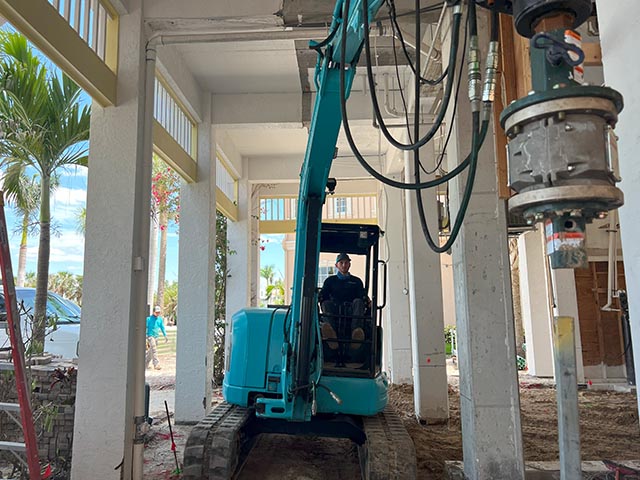
With helicals being the logical choice in providing the support needed for this beachfront home, our team mobilized and performed a static load test in March of 2023. Utilizing Helical Micro Pulldown Piles, our original test piling secured 32 tons in compression and traveled to 34 feet, securing 4,800 ft/lbs of torque (which translates to 24 tons in compression). The installed 5″ grout column provided an additional 8 tons of compressive strength, netting the installed piling approximately .592 KIPS.
RESULT
On the interior of the project, we installed 20 Underpinning Pilings. These pilings will provided immense support the the home’s foundation and increased its load carrying capacity substantially.
PRODUCTS
Installed (20) SS150 8” x 10” x 12” 76″
2 Piles were met with “refusal” at 18 foot. Each required a 16” Helix extension.
2 additional 16” Helix extensions were installed as well, for a total of 4.
New Foundation (Interior)
Installed (28) SS150 8” x 10” x 12” 76″
12 Piles were met with “refusal” at 18 foot.
“Refusal” or “Spin- out” of a helical pile occurs when the pile refuses to penetrate while continuing to rotate during installation. Spin-out can occur when the soil’s resistance to penetration exceeds the downward thrust generated by the helix plates and the crowd pressure applied by the 28,000# excavator. Spin-out usually occurs at the conversion between a dense soil layer and bedrock when the helix plates confront hard/very dense material. Helical pile spin-out (refusal) affects the load capacity, and the means to predict said capacity via torque correlation. Once the helical pile tip (3.5” Diameter) encounters lime rock, the installation torque can no longer be commuted. The digital torque indicator may only record as the helical pile is progressing and creating torque resistance. Therefore, the bearing capacity of spin-out piles can only be determined definitively with an actual static load test. When the helical pile has spun-out on bedrock, the capacity can be assumed to be limited to the structural strength of the bottom-most helix plate – assuming the bedrock is strong enough to bear the load. In this representation, the lower most helix plate reflects the following design perimeters.”